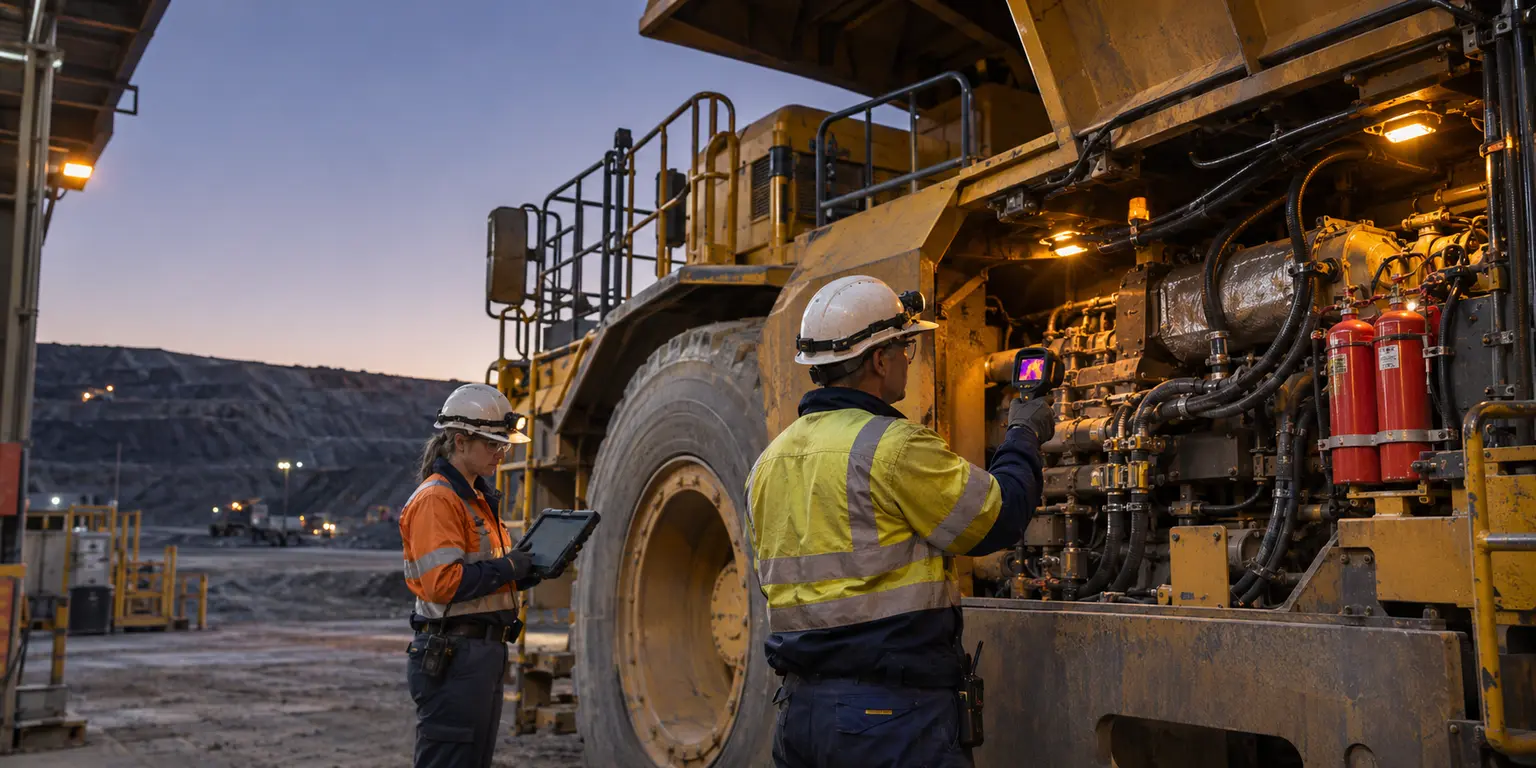
The latest NSW data should end any temptation to treat fires on mobile plant as a maintenance statistic.
The NSW Resources Regulator’s newly released FY26 report records 183 notified fires on mobile plant between 1 July 2025 and 30 June 2026. That was a 2% increase on the previous year and the second-lowest total in six years. More revealingly, notices issued in response rose from two to 10.
Those figures do not, by themselves, prove that fire risk worsened or explain why enforcement increased. They do show why leaders need to look beyond the annual count. The stronger question is whether the controls intended to prevent, detect, suppress and recover from a fire are performing as designed — and whether the organisation can prove it.
The pattern is operational, not abstract
Surface coal mines accounted for 72% of FY26 notifications, while underground metalliferous mines accounted for just over 14%. The most common heat-and-fuel combination was exhaust system plus hydraulic oil: 22 of the 183 notified incidents.
That combination matters because it describes an interface between energy and fuel. It points leaders toward the condition of hoses, routing, shielding, lagging, leak detection, maintenance quality and separation from hot surfaces — not merely whether a fire extinguisher was present.
The report’s significant incidents make that distinction tangible. In one tele-remote loader fire, a failed hydraulic hose sprayed oil into the engine bay; the onboard suppression system activated but did not fully extinguish the fire. In another underground haul-truck event, oil leaked onto turbo lagging before ignition. These are individual incidents, not a representative sample of all 183 notifications, but they illustrate how prevention, suppression and recovery controls can interact.
The Regulator’s broader mobile-plant fire guidance identifies maintenance and inspection systems, temperature and pressure monitoring, automatic or manual suppression, handheld extinguishers and emergency escape systems among the relevant controls. Its Mechanical Engineering Control Plan code of practice also directs mines to consider fuel and ignition sources, prevention of initiation and propagation, early detection and suppression.
A fire event is therefore not evidence of one failed item. It is a test of a control system.
Four control questions executives should ask
1. Are prevention controls defined at the failure interface?
A generic requirement to “inspect the machine” is difficult to assure. A useful performance standard identifies the specific condition that must be maintained, the failure modes that matter, the tolerance, the owner and the evidence required.
For mobile-plant fire risk, that may include how hydraulic hoses are routed and protected, how combustible contamination is controlled, how hot surfaces are shielded, how electrical connections are maintained, and what evidence demonstrates that the design intent remains intact after modification or repair.
The precise standard must come from the plant, site risk assessment, applicable law, engineering requirements and competent people. The leadership test is whether those sources have been converted into controls that can actually be verified.
2. Does verification test control health?
A completed inspection is activity. It is not automatically assurance.
Verification should show whether the control could perform when demanded. That means looking for objective evidence: condition records, test results, defect histories, suppression-system inspection and activation records, thermal or pressure data where applicable, maintenance closeout quality, photographs, and field confirmation against the approved standard.
The ICMM’s 2026 Critical Control Management guide reinforces this broader shift from identifying and documenting controls to verifying performance and acting on findings. For mobile-plant fires, that means testing the barriers at the fuel–ignition interface, not reporting only inspection completion.
3. Are incident findings connected back to the control standard?
Every notified fire creates information about what held, what degraded, what failed and what was absent. If investigations are filed as isolated equipment events, the organisation can miss recurring patterns across fleets, sites and contractors.
Use a consistent control taxonomy across the bowtie, maintenance system, investigation, verification program and executive reporting. Then ask:
- Which preventive control was expected to stop this pathway?
- What evidence shows its condition before the event?
- Did detection occur early enough?
- Did suppression activate and perform as intended?
- Was emergency egress practicable?
- Has the corrective action changed the control standard, verification method or design?
- What evidence is required before closeout?
This is where an investigation becomes an assurance input rather than a completed report.
4. Can leaders see repeat weakness without losing the source evidence?
Executives do not need every work order. They do need a defensible view of recurring control erosion.
A useful assurance view should connect heat source, fuel source, failed component, failure cause, plant class, operating context, suppression outcome, corrective action and verification evidence. It should also preserve the underlying records, because a trend without traceability can create false confidence.
The FY26 report itself demonstrates the value of structured incident data. It analyses notifications by mine type, location, principal hazard or control plan, response level, heat and fuel source, suppression method, failed component and cause. A site or company should be able to interrogate its own evidence with comparable discipline.
Why this matters now
Uncontrolled fire or explosion on mobile plant remains among the NSW Regulator’s FY27 mine-safety assessment priorities for coal and metalliferous operations.
The practical response is not another fire campaign followed by a return to normal reporting. It is a closed assurance loop:
- define the unwanted event and credible pathways
- specify the few controls that materially prevent or mitigate it
- set measurable performance requirements and evidence expectations
- verify control health in the field
- investigate events against those same controls
- update standards and verification when evidence exposes weakness
- retain accountable human approval for every material decision
That loop is engineering- and operations-led. AI can help structure the information, expose inconsistencies and maintain traceability, but it cannot determine that a machine is safe to operate or replace competent inspection, investigation or statutory judgement.
Where MineGuard AI fits
MineGuard AI’s Critical Risk AI turns site standards, procedures and risk registers into reviewable bowties, measurable performance standards and verification programs. Its published workflow supports defining owner, intent, measure, tolerance and evidence requirements; setting verification frequency, method and pass/fail criteria; identifying gaps and conflicts; and exporting controlled assurance packs. The work is AI-assisted and human-approved.
Incident AI supports the other half of the loop. It structures investigation evidence, surfaces gaps and conflicting accounts, builds source-linked timelines, and tests controls against what the evidence shows — including what held, failed or was missing. Findings remain subject to investigator review and approval.
This is consistent with MineGuard AI’s Responsible AI approach: the systems do not make final safety, engineering, legal or operational decisions. Authorised people validate, edit, approve or reject outputs and remain accountable for the result.
For mobile-plant fire risk, the commercial opportunity is not “AI predicts the next fire.” It is a more disciplined connection between the control standard, field verification, incident evidence and leadership action.
Book a MineGuard AI walkthrough to map one mobile-plant fire pathway from bowtie and performance standard through verification and incident learning, with evidence kept visible and approval kept with your people.
Key sources
- NSW Resources Regulator: Fires on mobile plant 2025–26
- NSW Resources Regulator: Fires on mobile plant safety
- NSW Resources Regulator: Mechanical Engineering Control Plan code of practice
- NSW Resources Regulator: FY27 compliance priorities
- ICMM: Critical Control Management Good Practice Guide, 2026
- MineGuard AI: Critical Risk AI
- MineGuard AI: Incident AI
- MineGuard AI: Responsible AI