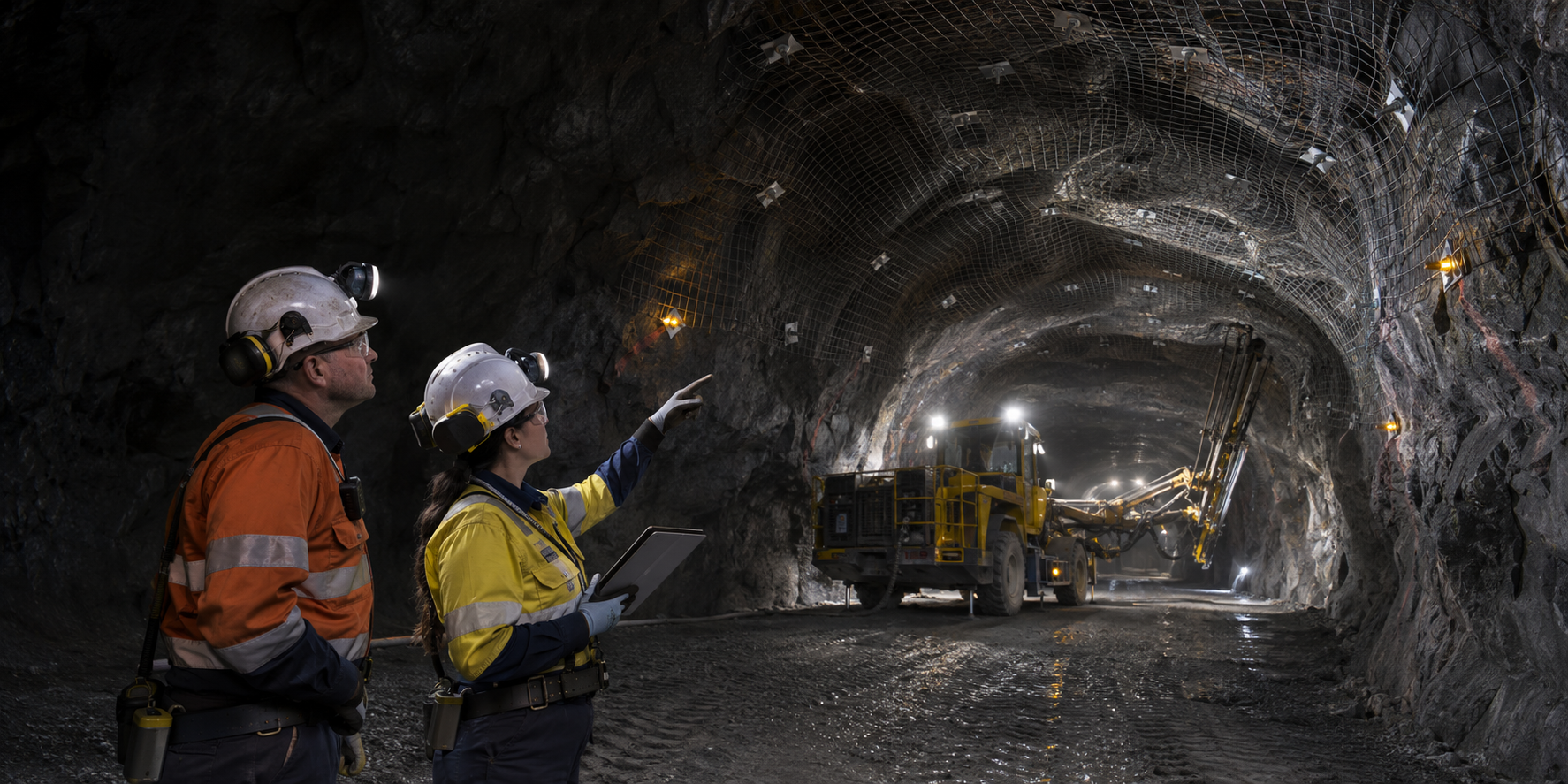
On 5 November 2026, the NSW Resources Regulator published its investigation into a roof collapse at an underground gold mine that seriously injured a jumbo operator. The immediate facts are confronting. The larger leadership lesson is more important: a ground-control design is only as reliable as the system that keeps its assumptions connected to changing conditions.
The roadway had been classified as low risk and supported to an original design. As development advanced, poor ground was observed, scaling created overbreak of up to 1.8 metres, geological structures formed a wedge in the roof, required QA/QC records were not completed, and the changed conditions were not escalated for geotechnical assessment. The Regulator found that the support design was not reassessed as excavation geometry and ground conditions changed.
This is not a case for automating geotechnical judgement. It is a case for making the evidence around that judgement harder to lose, disconnect or leave unresolved.
The risk was dynamic; the assurance system was not
Ground-control plans necessarily begin with models, classifications and design assumptions. Mining then creates new evidence: actual excavation geometry, mapping, monitoring results, inspection records, operator observations, support quality data and changes in geological conditions.
The executive question is whether that evidence can change the control response before the hazard changes the outcome.
In the NSW investigation, the original low-risk classification continued to shape the installed support even after field conditions departed from the design basis. The report describes missed or incomplete QA/QC inspections, unclear and inaccessible escalation information, inadequate contractor monitoring, geotechnical inspections not conducted at the required frequency, and earlier audit findings that had not been appropriately addressed.
The failure was therefore broader than one missing form. The information needed to challenge the original assumptions existed in observations, geometry and prior assurance work, but it did not become an accountable reassessment and control decision.
Strata control is becoming an evidence-architecture test
NSW has already signalled targeted assessments of strata-control arrangements from early 2027 across underground coal and metalliferous mines. The regulator says these assessments will examine hazard identification, risk assessment and critical-control implementation, including whether controls are implemented, maintained and functioning as intended.
That direction is consistent with recent assessment material. In a program covering 18 underground coal mines, the Regulator tested whether mine design was being accurately executed and updated for identified hazards, whether support remained effective, whether people were kept out of high-risk areas, and whether supervisors could access recent strata-monitoring history. A separate assessment of underground coal outbye areas recommended auditable collation of roadway inspections, strata-defect actions and closure reporting.
Western Australia's 2025 ground-control code frames the same discipline across mining scenarios: safe design supported by an integrated geotechnical database, correct implementation, and ongoing performance monitoring, review and updating through the mine life.
The common thread is not more paperwork. It is a traceable chain between:
- the assumptions that support the design
- the field evidence that may challenge those assumptions
- the trigger or tolerance that requires escalation
- the competent person who assesses the change
- the approved control response
- the verification evidence showing that response is implemented and effective
- the actions and approvals that close the loop
If those elements sit in separate documents, systems, shifts and organisations, leaders may receive a green status without seeing that the basis for green has expired.
Four leadership tests before the 2027 assessments
1. Can a field observation reach the design owner?
Test the real path, not the procedure diagram. Start with an observation of overbreak, changed structure, support damage or unexpected monitoring behaviour. Can a worker or contractor identify the applicable trigger, preserve the observation, reach the right supervisor and geotechnical authority, and see the decision returned to the work area?
A handover mention is not an escalation record. A submitted form is not closure. The chain must preserve what was observed, how it was assessed, what changed and who authorised continued work.
2. Are design assumptions treated as controlled conditions?
Critical assumptions should be explicit enough to test. For ground control, these may relate to excavation profile, geological domain, expected structure, stress regime, support installation quality, monitoring response or equipment position.
Leaders should ask which deviations require reassessment, whether the thresholds are unambiguous, and whether the current support standard still matches the actual conditions. Competent geotechnical people must make those decisions; the management system must ensure they receive the right evidence in time.
3. Does verification test control health or form completion?
The ICMM Critical Control Management guide updated in 2026 defines verification as a structured check that gathers evidence to confirm a critical control is in place and working as intended. That is different from counting completed inspections.
For a ground-control program, useful assurance may combine execution-to-design checks, support installation quality, roadway or excavation inspections, monitoring trends, trigger use, exclusion controls, supervisor access to historical information, contractor compliance and action closure. The method must fit the control and the site; no generic dashboard can replace technical assessment.
4. Are audit findings allowed to age without risk review?
The NSW report notes that a 2023 audit had identified deficiencies in ground-condition feedback, routine TARP use, QA/QC compliance checks and geotechnical resourcing that had not been appropriately addressed by the time of the incident.
An overdue action is not merely an administrative exception when it concerns a principal hazard. Governance should show the risk significance, interim controls, accountable owner, due date, evidence of completion and competent verification of effectiveness. Where the operating context changes while an action remains open, the risk decision should be revisited.
Where MineGuard AI fits, and where it must stop
The opportunity for AI is not to decide whether ground is competent or whether support is adequate. Those are site-specific engineering and operational decisions for authorised, competent people.
MineGuard AI's Critical Risk AI can support the structured control work around those decisions. Its published capabilities include grounding bowtie scope in site procedures, standards and registers; drafting human-reviewed bowties; defining measurable performance standards with owners, measures, tolerances and evidence requirements; designing verification logic; checking for vague or inconsistent control material; and preserving assumptions, decisions and approvals in a governance trail.
SHMS AI addresses the document-system side. MineGuard's official materials describe clause-level mapping, cross-document consistency checks, change-impact analysis, contradiction detection and cited findings across safety management systems, principal hazard plans, procedures, risk assessments and standards. Used under competent review, that can help identify where a changed TARP, inspection requirement or support standard has not flowed through the controlled document set.
For organisations whose main gap is the operating model, MineGuard AI Consulting documents services in data readiness, critical-control and safety-workflow transformation, governance, integration and implementation with human verification gates.
The boundary is explicit. MineGuard's Responsible AI principles state that the platform does not make final safety, engineering, legal or operational decisions. Outputs must be reviewed, validated and approved or rejected by authorised people. Its Trust & Security material describes evidence traceability, role-based access, audit logging, controlled retention and regional deployment options; certification and audit status are stated on that page and should be evaluated directly during procurement.
A practical starting point is one material unwanted event: uncontrolled ground or strata movement. Take the current bowtie, ground-control plan, TARPs, support standards, inspection forms, monitoring records and open audit actions, then test whether a competent reviewer can trace a changed field condition all the way to reassessment, control change, field communication and verified closure.
If that chain cannot be reconstructed, the problem is not a lack of data. It is a lack of connected, accountable evidence.
Book a MineGuard AI walkthrough to examine how Critical Risk AI, SHMS AI and governed implementation can strengthen the evidence system around critical controls while keeping geotechnical and operational authority with your people.
This article provides general information, not legal, engineering, geotechnical or site-specific safety advice. Mine operators should use current regulator material, applicable legal requirements and competent professional advice for their circumstances.
Key sources
- NSW Resources Regulator: Investigation report - worker seriously injured after roof collapse, November 2026
- NSW Resources Regulator: FY27 compliance priorities
- NSW Resources Regulator: Underground coal ground or strata failure assessment, February-December 2025
- NSW Resources Regulator: Ground or strata failure in underground coal outbye areas
- WorkSafe WA: Ground control for Western Australian mining operations - code of practice
- ICMM: Critical Control Management Good Practice Guide, 2026
- MineGuard AI: Critical Risk AI
- MineGuard AI: SHMS AI
- MineGuard AI: Responsible AI
- MineGuard AI: Trust & Security