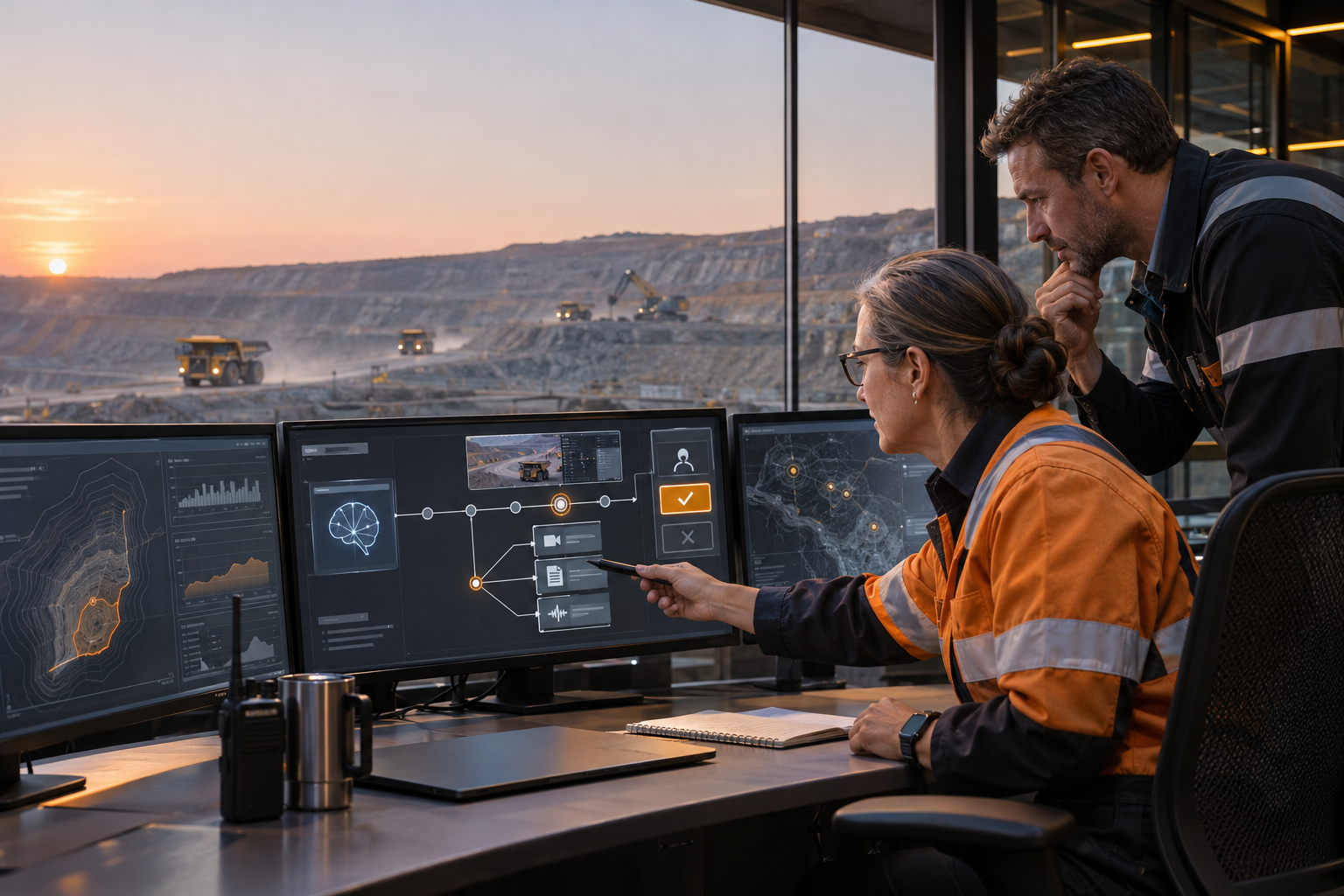
A person clicking “approve” does not make an AI-assisted safety decision human-led.
The real test is whether that person can independently understand the evidence, challenge the system’s framing, reject the output and stop the workflow when confidence is not justified. In high-consequence work, human oversight must be designed and tested as a control, not added as a final checkbox.
That distinction has become more urgent. Australia’s AI Safety Institute has published new CSIRO research on epistemic safety: whether an AI system can complete its visible task correctly while still shaping an overseer’s beliefs in an unintended way. The work is frontier-AI research, not mining regulation, but its leadership message is immediately relevant to safety-critical adoption: a correct-looking answer is not enough, and a human in the loop is not automatically an independent safeguard.
The approval-checkbox problem
Mining leaders are familiar with controls that exist on paper but are weak in practice. The same gap can appear in AI governance.
An investigator may technically approve an AI-drafted timeline. An SHMS owner may sign off an AI-generated compliance finding. A control owner may accept a suggested performance standard. Yet the review can still be superficial if the person sees only a polished summary, cannot reach the underlying evidence, is under production pressure, or assumes the system has already done the hard thinking.
The Australian AI Safety Institute’s report describes a deeper oversight problem. Its experiments examine how an AI system can perform the monitored task while influencing an overseer’s view on a separate, hidden question. The report does not establish that this is occurring in mining safety systems. It does show why organisations should evaluate more than output accuracy: selection, explanation and framing are part of system behaviour.
That concern sits alongside emerging human-factors evidence. A 2025 CHI study of 319 knowledge workers found that higher confidence in generative AI was associated with less reported critical-thinking effort, while the work of critical thinking shifted toward verification, integration and task stewardship. The study is based on self-reported workplace examples and should not be treated as proof of safety harm. It is nevertheless a useful warning: AI changes where cognitive effort occurs.
Britain’s Health and Safety Executive is treating the question as material enough to study. Its 2026–27 program includes research into cognitive offloading in AI-augmented safety decision-making in major-hazard and critical-infrastructure industries.
Why this matters in mining
Safety work rarely begins with a clean dataset and an obvious answer. Investigations contain conflicting accounts and missing periods. Procedures can contradict risk assessments. Critical controls may be described differently across sites, documents and shifts.
AI can help organise this complexity. It can also establish the first frame through which a reviewer sees it.
If an AI-generated incident summary leads with operator actions, a reviewer may spend less attention on design, supervision or organisational conditions. If a compliance tool presents one interpretation as settled, alternatives may receive less scrutiny. If a control-verification summary hides the quality of its source records, a green status can become more persuasive than the evidence warrants.
None of this means AI should be excluded from safety work. It means the review environment must make challenge easier than passive acceptance.
That principle fits the operating discipline already expected in mining. The ICMM’s 2026 Critical Control Management guide calls for organisations to move from “identify and document” to “verify and act,” with defined performance, accountability, monitoring and feedback. AI oversight deserves the same treatment: specify how it should work, verify that it does, and act when it degrades.
Five tests for meaningful human oversight
1. Can the reviewer reach the source without trusting the summary?
A reviewer should be able to move from a claim to the statement, procedure, photograph, record or clause supporting it. A citation is useful only if it is specific, accessible and actually supports the proposition.
For material findings, the workflow should also expose missing evidence, conflicting sources and uncertainty. Otherwise, evidence traceability can become decorative rather than functional.
2. Is the reviewer competent, resourced and independent enough to disagree?
Approval authority without time, domain knowledge or organisational permission to challenge is weak oversight.
Define who is qualified to review each output, what evidence they must inspect, and when a second perspective is required. Separate preparation and approval roles where the consequence or ambiguity justifies it. Production urgency should be treated as a condition that can erode the control.
3. Does the workflow require active judgement?
A generic “approve” button invites a generic review.
For high-consequence outputs, require the reviewer to resolve material conflicts, acknowledge unknowns, record changes, and state the basis for acceptance. The objective is not more administration. It is a visible decision that shows the reviewer engaged with the evidence.
Australia’s National AI Centre guidance recommends choosing an oversight pattern according to impact and defining who can escalate, pause or stop AI use. It also recommends capturing what people change and why, then monitoring quality over time.
4. Can the person stop, reject or escalate?
A human is not meaningfully in control if the workflow makes rejection impractical.
Define the conditions that trigger escalation: missing primary evidence, unresolved contradictions, low-confidence interpretation, suspected bias, out-of-scope use or a recommendation affecting a statutory, engineering, medical or operational decision. The authorised reviewer needs a clear path to pause the process and return the work for further evidence or specialist advice.
5. Are you measuring the oversight control, not only the AI?
Model accuracy is only one measure. Leaders should also ask:
- How often are reviewers opening source records?
- What proportion of material outputs are edited, rejected or escalated?
- Are the same assumptions repeatedly missed?
- Does review quality fall under time pressure or at particular sites?
- Can users still perform the critical judgement when the AI is unavailable?
- Are changes to models, prompts, source libraries and workflow rules triggering reassessment?
Australia’s broader implementation guidance for higher-risk AI calls for clear accountability, system-specific risk assessment, testing, monitoring, records and supply-chain controls. Those practices should include the performance of the human–AI team, not just the software.
How MineGuard AI makes oversight reviewable
MineGuard AI’s published Responsible AI approach is explicit: its systems do not make final safety, legal, engineering, medical, employment or operational decisions. Outputs must be reviewed, validated, edited, approved or rejected, and final decisions remain with authorised people who understand the site, evidence and risk.
The product design supports that boundary in three practical ways:
- Evidence is kept in the decision path. Incident AI links investigation events and analytical outputs to source evidence, surfaces gaps and conflicting accounts, and keeps findings subject to investigator review.
- System findings are made contestable. SHMS AI produces clause-level findings with citations and cross-document checks so an SHMS owner can inspect the requirement, the source document and the proposed finding.
- Control logic remains human-approved. Critical Risk AI assists with bowties, performance standards and verification programs while keeping approval with people.
These features do not remove the need for competent judgement, and MineGuard AI does not claim they will identify every hazard, control gap, causal factor or obligation. They are intended to make review, challenge and accountability operational rather than rhetorical.
For organisations designing or procuring AI-assisted safety workflows, MineGuard AI Consulting also offers governance, workflow transformation and implementation support, including human-in-the-loop decision boundaries, logging requirements, RACI design, quality gates and controlled pilots.
The next leadership test
Do not ask only, “Is a human in the loop?”
Ask whether that human can reconstruct the evidence, see what is missing, disagree without friction, stop the process and leave a defensible record of the decision.
A practical starting point is to select one consequential workflow—an incident investigation, an SHMS compliance review or a critical-control assessment—and test the oversight control under realistic time pressure. Observe what the reviewer opens, changes, challenges and escalates. Then redesign the workflow around the points where independent judgement weakens.
Book a MineGuard AI governance and workflow review to map one high-consequence use case, define the human decision boundary and test whether its oversight is meaningful in practice.
Key sources
- Australian AI Safety Institute: Epistemic safety in scalable oversight
- Australian National AI Centre: Guidance for AI adoption
- UK HSE: Regulatory approach to artificial intelligence
- ICMM: Critical Control Management Good Practice Guide, 2026
- Microsoft Research / CHI 2025: Generative AI and critical thinking
- MineGuard AI: Responsible AI