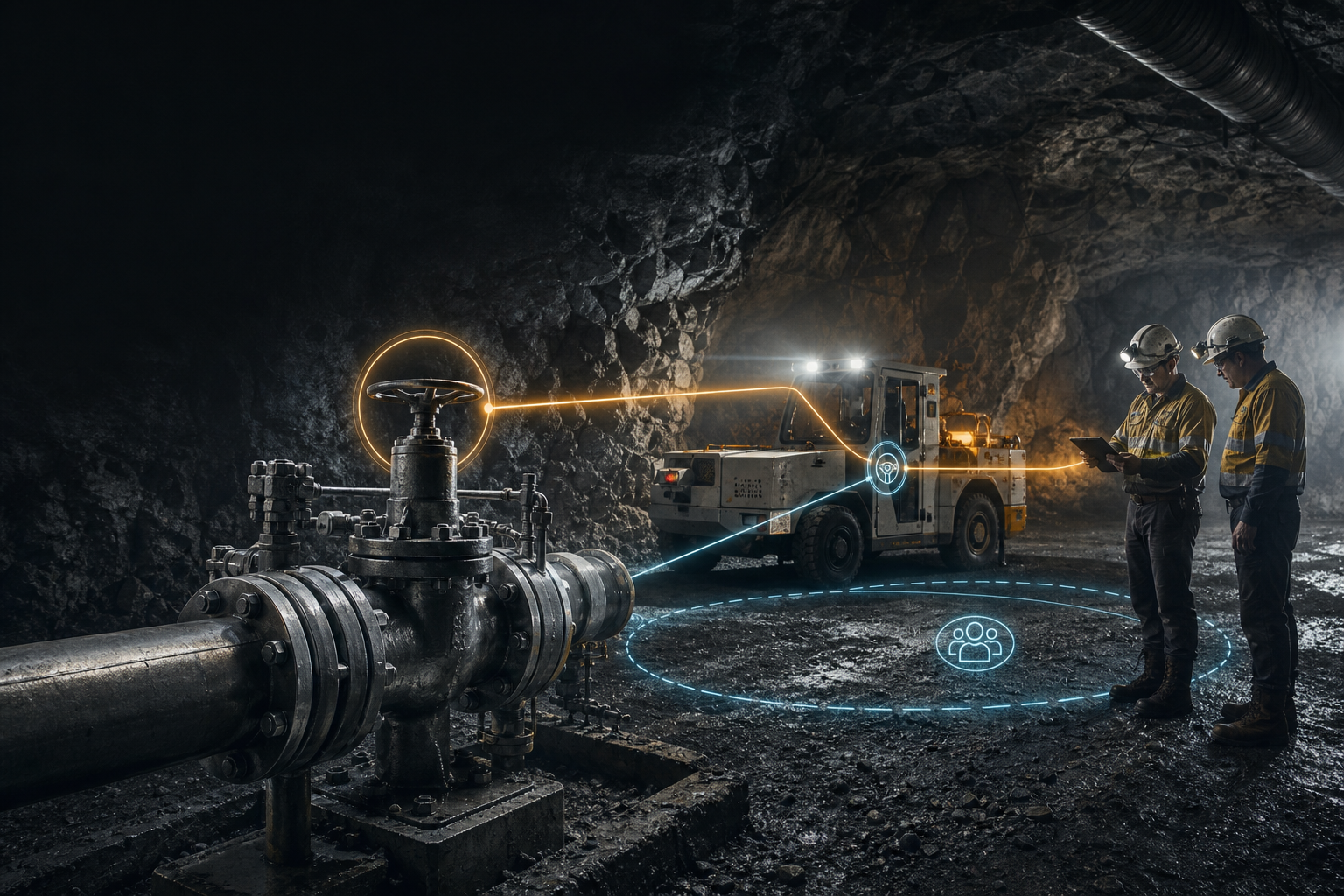
A serious event rarely arrives in the neat shape of a single hazard and a single failed control.
A recent Queensland mining safety alert makes that point without inviting premature conclusions. On 12 September 2026, a worker was seriously injured during maintenance on a compressed-air line at an underground coal mine. Resources Safety & Health Queensland (RSHQ) reported an uncontrolled release of compressed air, dust and reduced visibility, a fall from a vehicle, and subsequent vehicle movement. The precise sequence and circumstances remain under investigation.
That caveat matters. The alert is not a final causal finding. But its initial advice is already instructive: operators should examine stored energy, access arrangements, exclusion zones, worker-mobile equipment interaction, abnormal conditions, task-based risk management and reassessment when conditions change.
For leaders, the broader lesson is clear: an investigation that asks only "which control failed?" may be too narrow. High-consequence events can emerge at the interfaces between several hazard and control systems. The investigation must reconstruct those interactions without compressing uncertainty into a convenient story.
From a failed control to a changing system
Traditional investigation tools are often strongest when the event can be represented as a linear chain. Complex field work is less cooperative.
A maintenance task may involve an energy-isolation system, an access system, mobile equipment, communications, exclusion zones and a task risk assessment. A change in one condition can alter the demands on every other control. Reduced visibility can affect communication and vehicle movement. An improvised access position can change exposure to stored energy. An abnormal component condition can invalidate assumptions in the original task plan.
This does not mean every control was absent or ineffective in the Queensland event. That determination belongs to the investigation. It means the evidence should be organised so investigators can test the condition and performance of each relevant control, the sequence in which conditions changed, and the points at which systems interacted.
The RSHQ alert explicitly calls for controls to be reassessed when conditions change or unexpected circumstances arise. That is more than a pre-start instruction. It is also an investigation question: what changed, who could observe it, what decision was required, and what evidence shows how the system responded?
Current guidance raises the investigation standard
The ICMM Critical Control Management Good Practice Guide, updated in 2026, says critical-control performance should be defined through specific, measurable and realistic requirements. Verification should check whether those requirements are being met in practice, including how a control can erode or be compromised.
Crucially, the guide also notes that organisations may need to review their incident investigation methods to ensure they assess the status of critical controls and gather causal information where a critical control was absent or failed. It warns that many common investigation methods do not address this explicitly enough.
That is not an argument for turning every investigation into a bowtie workshop. It is an argument for joining three evidence views:
- Event evidence: what happened, in what sequence, and what remains unknown
- Control evidence: which controls were expected, what performance was required, and what their state was
- System evidence: which procedures, competencies, maintenance processes, authorisations and operating conditions supported or weakened those controls
Western Australian guidance points to the same practical complexity. A 2025 WorkSafe mines safety bulletin on spotters reported more than 130 incidents a year across more than 80 mine sites and described exposure spanning stored energy, falls, falling objects and uncontrolled plant movement. Its listed contributory factors included inadequate task planning, poorly defined exclusion zones and inadequate verification of task-specific competency.
The point is not that a spotter solves every interface. It is that a control can only be judged in the operating context in which people rely on it.
Five disciplines for investigating control interactions
1. Build a condition timeline, not only an event timeline
Record changes in energy state, equipment status, work position, visibility, communications, personnel and task scope. Put verified facts, witness accounts and open questions in distinct categories.
A confident chronology built from mixed-quality evidence is less useful than a transparent chronology that shows what is known, disputed and missing.
2. Map every relevant control system
Do not force the event into the first familiar fatal-risk category. Map the controls associated with each material hazard and then identify the interfaces between them.
For a maintenance event, that may include isolation and depressurisation, access, exclusion, mobile-equipment movement, supervision, communications and stop-work or reassessment triggers.
3. Test control state against a defined standard
"Procedure existed" is not a control-state finding. Investigators need to know what the control was required to do, under what conditions, and what evidence demonstrates whether it was available and effective.
ICMM distinguishes design adequacy from implementation effectiveness. Both matter: a well-designed control may not be implemented, while a faithfully implemented control may be inadequate for the actual conditions.
4. Preserve uncertainty and competing explanations
Early evidence is incomplete. Interviews can conflict. Digital records may have different timestamps. Physical evidence may support more than one sequence.
The investigation record should preserve those tensions until competent investigators resolve them. AI can help organise material and surface gaps, but it must not turn an inference into a fact or close an issue merely because one narrative is linguistically coherent.
5. Design actions across the interfaces
Corrective actions should follow the evidence chain. If the event exposed an interaction between systems, an action confined to one procedure may leave the interface unchanged.
Leaders should ask whether actions address control design, field implementation, supporting activities, change triggers and verification. Closure evidence should show that the intended change was made and reviewed by the accountable person.
What executives should ask to see
A concise investigation assurance view should show:
- the verified sequence and material uncertainties
- the hazard and control systems examined
- expected control performance and observed control state
- changes or abnormal conditions and the required response
- evidence supporting each material finding
- actions mapped to findings and control weaknesses
- named human reviewers and approvers
This is not more paperwork. It is a more defensible structure for learning and decision-making.
Where MineGuard AI fits
MineGuard AI's Incident AI is designed for this evidence-heavy work. Its published workflow supports ingesting documents, emails, PDFs, photos and statements; structuring evidence-linked timelines; preparing interview questions; surfacing evidence-gap suggestions; and drafting investigation material. All outcomes require investigator review and approval before export.
Where an investigation needs to connect findings back to risk controls, Critical Risk AI supports human-approved bowties containing threats, degraded controls, escalation factors and recovery pathways, alongside measurable performance standards and verification programs.
SHMS AI addresses the document-system side: it is designed to detect gaps and contradictions across safety management systems, procedures, risk assessments and principal hazard plans, with clause-level citations and change-impact outputs.
These products do not replace investigators, control owners or site leadership. MineGuard's trust framework states that workflows are human-in-the-loop, with evidence traceability, named approval and audit logging. That boundary is essential: AI should make the evidence chain easier to inspect, not make a safety conclusion harder to challenge.
A practical starting point is to take one completed high-potential investigation and test whether every material finding can be traced to source evidence, a clearly defined control expectation, an observed control state and an accountable action. Gaps in that chain reveal where investigation workflow, data readiness or control architecture needs attention.
Book a MineGuard AI walkthrough to see how Incident AI, Critical Risk AI and SHMS AI can support evidence-anchored investigation and control learning while keeping judgement and approval with your people.
Key sources
- Resources Safety & Health Queensland: Serious accident involving a pressurised compressed-air system and mobile equipment, 14 September 2026
- ICMM: Critical Control Management Good Practice Guide, 2026
- NSW Resources Regulator: Safety Bulletin SB21-08 — Incident investigations
- WorkSafe Western Australia: Mines Safety Bulletin No. 182 — Competency of spotters for mobile load carrying equipment
- MineGuard AI: Incident AI
- MineGuard AI: Critical Risk AI
- MineGuard AI: SHMS AI
- MineGuard AI: Trust & Security