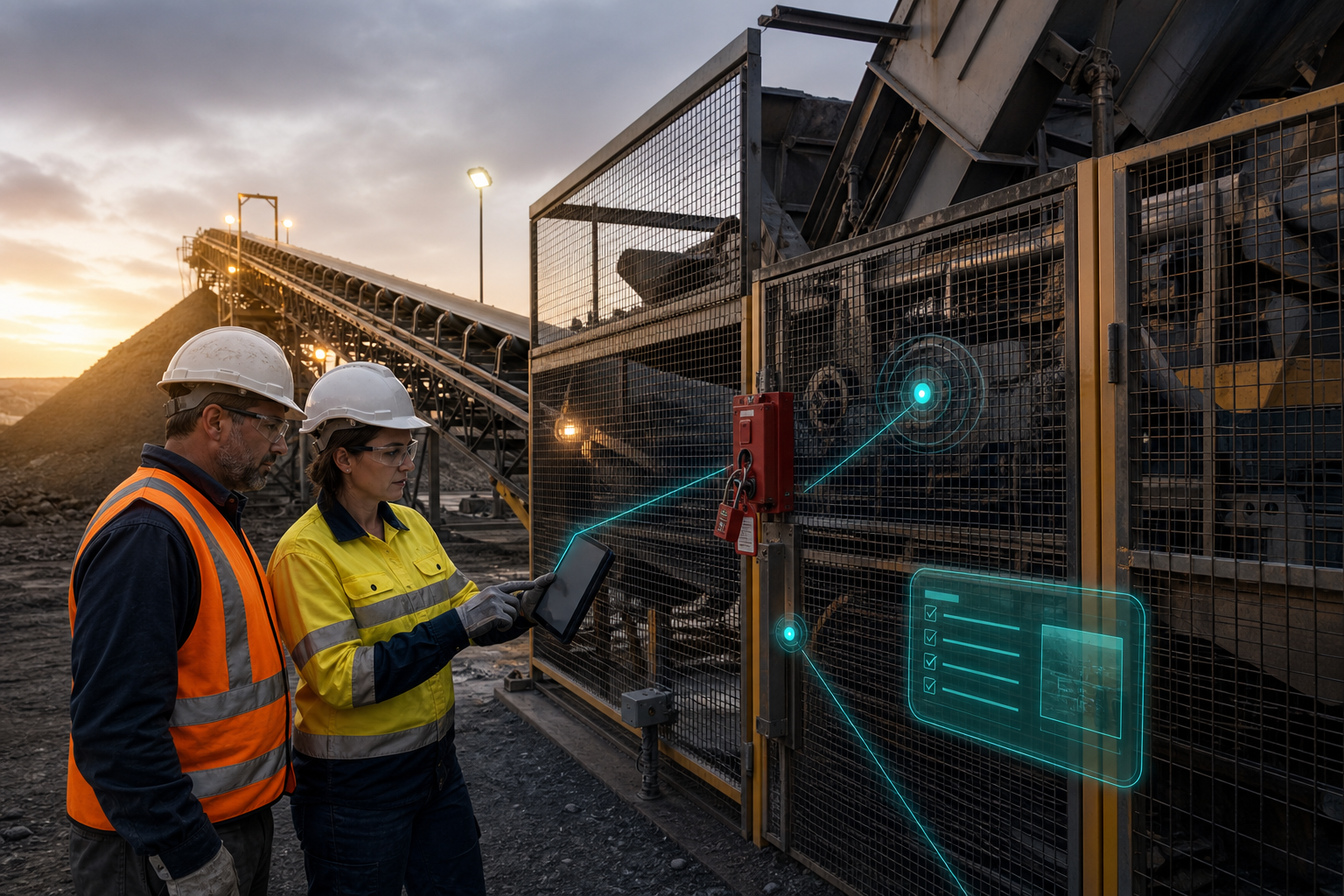
New South Wales has just published one of the clearest recent tests of machinery-control integrity across mining.
In an assessment of 226 small and metalliferous mines, the Resources Regulator recorded 257 issues against criteria for guarding, isolation, safe standing zones and hazardous-energy treatment. The largest category was whether guarding was correctly installed and maintained: 106 findings. Another 51 concerned workers' understanding of how to identify, isolate, dissipate and verify energy sources. The program issued 285 compliance notices to 143 mines, although the regulator cautions that those notices may include matters outside the assessment topic. NSW Resources Regulator, September 2026
A parallel assessment at 49 surface, processing and underground coal mines recorded 26 issues against the same control criteria, including 18 concerning guarding condition. It issued 59 notices to 30 mines, with the same caveat about scope. NSW Resources Regulator, September 2026
These are not simply reminders to deliver another toolbox talk. They expose a management-system problem: the physical control, the isolation method, the procedure, worker understanding and verification evidence must remain aligned as plant and work change.
The warning is wider than one assessment
The pattern also appears across jurisdictions.
In June 2026, Resources Safety and Health Queensland warned that inspections continued to find generating and mobile plant with no isolation facility, isolation points that could not be locked in the off position, and locks that were incompatible with the isolation hardware. RSHQ told site senior executives to audit operating plant for appropriate isolation facilities. RSHQ Safety Alert No. 475
NSW's July high-visibility campaign adds scale. Inspectors attended 123 mine sites and issued 321 compliance notices at 85 sites. Within mechanical engineering control-plan topics, unintended interaction with rotating or moving equipment was the leading subject of notices. The regulator also described a useful feature of stronger sites: incidents and actions were recorded consistently, closure evidence was attached, and later checks tested whether actions had been implemented effectively. NSW Resources Regulator, High Visibility Campaign 2026
The evidence does not show that every site has the same weakness, nor that paperwork alone caused any particular event. It does show that machinery risk is repeatedly escaping the boundary between documented intent and operating reality.
A guard is hardware. Guarding is a system.
A fixed guard can be present during an audit and still be unreliable as a control.
It may be removed with unrestricted tools. An access panel may not match the isolation procedure. A conveyor-tracking task may place a worker inside the danger zone. A personal lock may not fit newly introduced equipment. Residual hydraulic, pneumatic, gravitational or spring energy may be omitted from the isolation sequence.
That is why the NSW assessment criteria reach beyond the presence of a guard. They examine restricted tool access, two-handed controls, safe standing zones, isolation and energy dissipation. The recommendations connect plant condition with authorisation, training, task observation and fit-for-purpose isolation equipment. NSW Resources Regulator, Extractives Assessment
Safe Work Australia's model plant code takes the same lifecycle view. Its isolation guidance addresses multiple energy sources, lockable isolation points and individual control of locks during maintenance, cleaning and repair. The code is guidance and its legal effect depends on adoption in the relevant jurisdiction. Safe Work Australia, Managing Risks of Plant in the Workplace
For leaders, the practical conclusion is straightforward: training is necessary, but it cannot compensate for incompatible hardware, inaccessible isolation points, uncontrolled guard removal or a verification process that checks documents without testing the plant.
Five questions for executive assurance
1. Are the controls defined at the level people can test?
"Guarding in place" is too broad for assurance. A usable control standard should say what must be fitted, where, under what operating conditions, who owns it, how it is tested, what evidence is retained and what result is unacceptable.
The same discipline applies to isolation. Leaders should be able to distinguish shutdown from isolation, identify every relevant energy source, and see how zero-energy state and stored-energy treatment are verified.
2. Do the documents agree?
Compare the mechanical engineering control plan, risk assessment, isolation standard, maintenance procedure, task instruction and inspection form.
If one document requires a lockable local isolator while another permits a stop control, or if a risk assessment assumes a guard that the maintenance procedure requires workers to remove, the organisation has created ambiguity at the point of work.
3. Does verification test the physical control?
A completed checklist is not evidence of effectiveness unless the check tests the control's defined performance.
For guarding, evidence may include condition, security, reach distance, interlock function and control of removal tools. For isolation, it may include hardware compatibility, identification of energy sources, dissipation, try-test-verify steps and treatment of residual energy. The exact method must suit the plant, task and jurisdiction and be approved by competent people.
4. Can the business detect change before the field does?
Plant modifications, replacement components, contractor equipment and revised maintenance methods can invalidate assumptions distributed across several controlled documents.
Change control should identify every affected control, procedure, verification activity and training requirement. Procurement and maintenance decisions belong inside the assurance chain, not outside it.
5. Does a failed control force a decision?
When a guard is defective or isolation cannot be proven, the system should make the authority boundary clear: who stops the task, what interim protection is permissible, who approves restoration, and what evidence is required before return to service.
This is where control assurance becomes operational governance rather than reporting.
Where MineGuard AI fits
The opportunity for AI is not to decide that machinery is safe. It is to help competent teams structure the control logic, expose contradictions and preserve the evidence needed for human decisions.
Critical Risk AI is designed to turn site standards, procedures and risk registers into reviewable bowties, critical controls, measurable performance standards and verification programs. Its published workflow supports defining owner, intent, measure, tolerance and evidence requirements; setting verification frequency, method and pass/fail criteria; checking for vague or non-verifiable controls; and exporting assurance packs. The product drafts and structures this material for human review and approval.
SHMS AI provides a complementary document-assurance workflow. It maps safety-system documents against legislation and internal requirements, detects gaps and contradictions across documents, and returns clause-level findings with citations and ranked remediation. A mechanical engineering control plan and its linked isolation procedures, risk assessments and task documents are a practical, bounded starting scope.
MineGuard's published trust model keeps named people at the decision gate: AI-generated outputs are presented for inspection and can be edited, challenged or rejected before approval. That boundary matters. No document analysis can confirm the state of a guard, prove zero energy or replace a competent field inspection.
The commercially useful next step is therefore narrow and testable: select one high-consequence machinery scenario, assemble the controlled documents and recent verification evidence, define what effective control performance looks like, and test whether the system can trace each requirement from source to field check to accountable decision.
Book a MineGuard AI walkthrough to see how Critical Risk AI and SHMS AI can support a governed review of machinery controls while keeping technical judgement and approval with your people.
Key sources
- NSW Resources Regulator: Unintended interaction with rotating or moving equipment, small and metalliferous mines, September 2026
- NSW Resources Regulator: Unintended interaction with rotating or moving equipment, coal mines, September 2026
- NSW Resources Regulator: High Visibility Campaign 2026
- Resources Safety and Health Queensland: Ineffective isolation of generating and mobile plant, June 2026
- Safe Work Australia: Model Code of Practice, Managing Risks of Plant in the Workplace
- MineGuard AI: Critical Risk AI
- MineGuard AI: SHMS AI
- MineGuard AI: Trust & Security