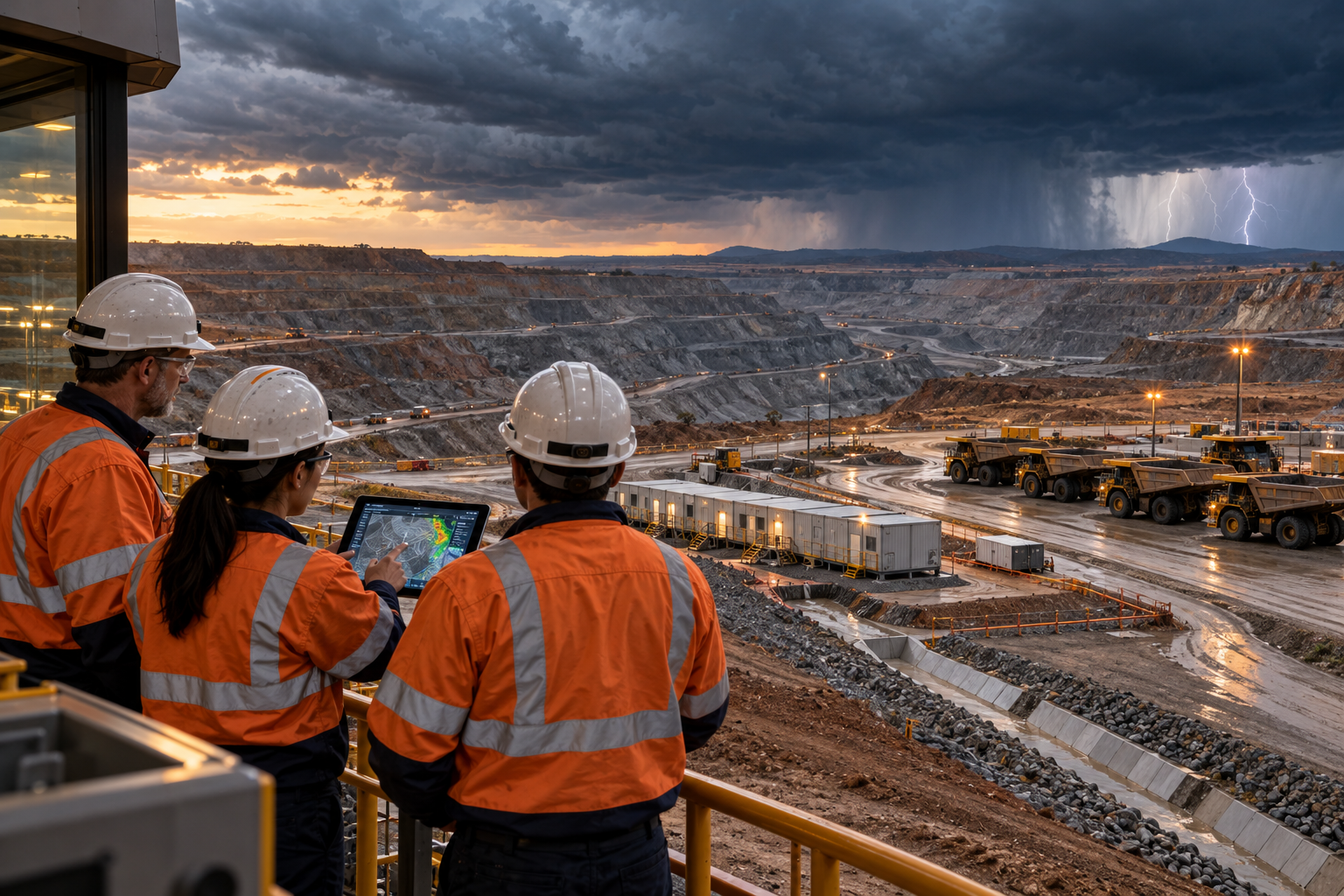
Queensland's storm season has begun, and the leadership question is not whether a site has a weather checklist. It is whether the safety system can translate changing conditions into timely, accountable decisions.
On 12 October 2026, Resources Safety & Health Queensland (RSHQ) issued an updated storm-season safety alert. It calls for emergency management planning, seasonal risk assessment, worker training, warning and evacuation systems, tracked actions, and adequate response and rescue capability. It also points to interacting hazards: flooding, lightning, high winds, unstable structures, wet-weather blasting risks and loss of safe access.
The message for mining leaders is broader than preparedness. Storm readiness is a live test of whether the SHMS, emergency plan, principal hazard plans, procedures, trigger-action plans, contractor arrangements and field controls still agree when conditions move.
The forecast is an input, not the control
The Bureau of Meteorology's 6 October tropical update forecast an increased chance of above-average rainfall across most of Queensland for 10–23 October and noted that the northern wet season officially began on 1 October. Its October-to-January outlook also projects above-average daytime temperatures across most of Australia and above-average rainfall across western and southern Queensland for October–December, while showing a drier signal elsewhere.
That variability is precisely why a seasonal outlook cannot be treated as a site control. Forecasts inform decisions; they do not replace local inspection, monitoring, risk assessment, competent technical advice or defined operating triggers.
RSHQ recommends that sites build seasonal risk assessments from their specific conditions, including drainage, water levels, structural integrity, geotechnical hazards, forecasts and technical reports. The practical leadership test is whether that changing evidence reaches the right decision-maker before a threshold is crossed.
Storm risk exposes system interfaces
Severe weather rarely challenges one document or one control at a time.
A rainfall forecast can affect pit access, slope conditions, water storage, evacuation routes and contractor mobilisation. Lightning can change whether mobile equipment operates and where people take shelter. Wet conditions can affect explosives selection and misfire risk. High winds can challenge temporary structures, cranes, tanks, conveyors and communications infrastructure.
Each hazard may already be addressed somewhere. The risk appears at the interfaces:
- the emergency plan assumes an evacuation route that the water-management plan identifies as flood-prone
- a lightning procedure stops field work, but contractor instructions use a different trigger or refuge location
- a seasonal inspection finds a drainage weakness, but the action is not reflected in the operating plan
- recovery criteria allow work to restart before geotechnical, electrical or access controls have been re-verified
- a corporate template names roles that do not match the site's current roster or mutual-assistance arrangements
A document can be current in isolation and still be unsafe as part of the wider system.
Five questions for an assurance-ready storm plan
1. What conditions change the operating state?
Triggers should be explicit enough to drive consistent action. Leaders should know which forecast, observation or instrument reading changes the site's operating state; who makes the decision; how it is communicated; and what evidence is retained.
"Monitor the weather" is not a decision rule.
2. Do the controls have measurable performance requirements?
For each material storm-related risk, the required control state should be clear. That may include the availability of safe refuge, communications, drainage capacity, structural anchoring, emergency equipment, access routes or verification after a severe event.
The specific standard belongs to the operation and its competent people. The governance requirement is that it can be checked, challenged and approved.
3. Do all linked documents tell the same story?
RSHQ says the emergency management plan should sit within the relevant safety management system and be based on risk assessment. That creates a cross-document obligation in practice: hazards, responsibilities, triggers and response arrangements need to remain aligned across the system.
Seasonal preparation should therefore include an impact scan, not just a checklist review. When a risk assumption or control changes, teams need to identify every downstream document, form, training package and contractor interface that depends on it.
4. Can every person act on the plan?
Safe Work Australia's emergency-planning guidance emphasises accessible plans, defined responsibilities, training, testing, reliable communications and arrangements for contractors, visitors, remote workers and neighbouring businesses.
A technically sound plan that cannot be understood or executed on night shift, during a communications disruption or by a newly mobilised contractor is not operationally ready.
5. Is recovery governed as tightly as shutdown?
The pressure to resume production can be strongest when evidence is incomplete. Recovery criteria should identify what must be inspected, tested and approved before work restarts, who has authority to release each area or activity, and what temporary controls remain in place.
A return to work should be a controlled decision supported by current evidence, not the default after the warning passes.
What leadership should ask to see
A concise storm-readiness assurance pack should show:
- the current seasonal risk assessment and the evidence used
- material hazards and the controls relied upon
- defined warning, shutdown, evacuation and recovery triggers
- named owners and decision authorities
- open actions, due dates and interim controls
- alignment across the SHMS, emergency plan and linked documents
- contractor, remote-work and mutual-assistance arrangements
- exercise results and evidence that identified gaps were closed
- the latest approvals and change history
This is not a request for another dashboard. It is a request for a defensible chain from changing conditions to control status to human decision.
Where MineGuard AI fits
This work is document-heavy, repetitive and vulnerable to drift, but the decisions remain human.
MineGuard AI's SHMS AI is designed to ingest safety management systems, procedures, risk assessments, principal hazard plans and standards; map requirements; identify gaps and contradictions across documents; and return clause-level findings with citations. Its published workflow also includes change-impact analysis, version comparison, audit-question generation and human-reviewed outputs. Applied to a bounded storm-readiness document set, those capabilities can help reviewers find where assumptions, triggers, roles or controls no longer line up.
Critical Risk AI supports human-approved bowties, measurable performance standards and verification programs. That is relevant where storm conditions can degrade a critical control or introduce an escalation factor that needs an explicit verification method, tolerance and evidence requirement.
For organisations that first need to redesign the workflow, MineGuard AI Consulting documents services for data readiness, safety-workflow transformation, governance and implementation planning. MineGuard's trust model keeps the boundary clear: AI drafts and surfaces evidence; competent people review, edit and approve the outcome, with traceability and audit logging.
MineGuard AI does not replace forecasts, inspections, engineering judgement, emergency command or statutory accountability. The commercial opportunity is more disciplined preparation: use AI to reduce the burden of finding contradictions and maintaining the evidence chain, while keeping operational authority with the people accountable for the site.
A practical first step is to select one storm-readiness document set and test whether every material trigger, control, owner and recovery criterion is consistent, current and traceable to source evidence.
Book a MineGuard AI walkthrough to see how SHMS AI, Critical Risk AI and governed implementation support can strengthen that review without delegating safety decisions to the model.
This article provides general information, not legal, engineering, weather or site-specific safety advice. Mine operators should use current regulator guidance, local forecasts, competent technical advice and their applicable legal requirements.
Key sources
- RSHQ: Managing the risks of storm season, 12 October 2026
- Bureau of Meteorology: Tropical Climate Update, 6 October 2026
- Bureau of Meteorology: Climate outlook for October to January, issued 24 September 2026
- Safe Work Australia: Emergency plans fact sheet
- MineGuard AI: SHMS AI
- MineGuard AI: Critical Risk AI
- MineGuard AI: Trust & Security