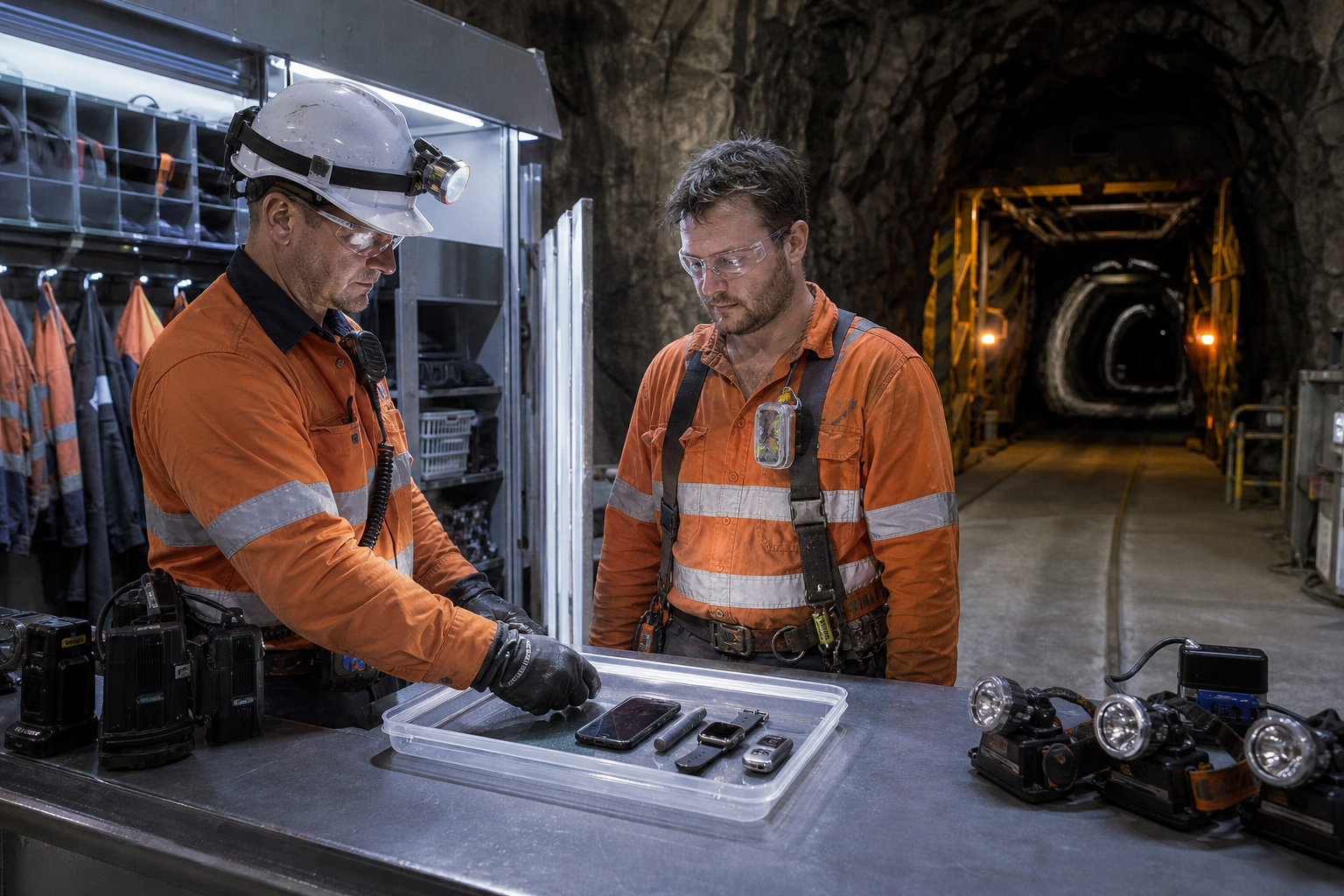
A sudden rise in contraband reports at Queensland underground coal mines should not be dismissed as a pocket-check problem.
On 11 September 2026, Resources Safety & Health Queensland (RSHQ) said it had received six reports of contraband underground at different coal mines in five months, including alleged use of vapes. Before 2026, the regulator said no contraband incident had been reported in Queensland underground coal mines for more than a decade.
That is a sharp change in reported events. It does not prove how often contraband was actually present before or after 2026. It does justify an immediate leadership question: can the operation demonstrate that its ignition-source controls are understood, applied and verified at every entry point, on every shift?
The hazard is small; the consequence is not
RSHQ's warning is direct. Underground coal mines may contain methane and combustible coal dust, and an unauthorised device capable of producing heat, a flame, an arc or a spark can create an ignition risk.
The regulator reported that SIMTARS testing found vapes could exceed 250°C in use and, if damaged, overheated or short-circuited, could generate more than 100 times the energy needed to ignite gas in an underground coal mine. RSHQ listed vapes, lighters, mobile phones, smart watches, digital watches and electronic car keys among prohibited items and urged operators to review the effectiveness of contraband controls, search procedures and worker-awareness programs.
The Coal Mining Safety and Health Regulation 2017 makes the system expectation clearer. It classifies smoking devices and devices capable of creating an open flame, arc or spark as contraband, subject to specified exceptions. It also requires an underground mine's safety and health management system to provide for a search procedure, including routine and random searches, the frequency, time and place of searches, the method used and a process that reaches underground workers over time.
A procedure is therefore necessary. The 2026 reports show why its existence is not sufficient evidence of effectiveness.
Treat contraband prevention as a control system
A weak response focuses on reminders, posters and a short enforcement campaign. A stronger response treats the issue as a layered control system with defined performance requirements.
That system may include:
- clear classification of prohibited and approved devices
- pre-entry self-checks and secure storage
- routine and random searches conducted in accordance with the site's procedure
- contractor and visitor onboarding
- supervision and field conversations
- approved-equipment controls
- reporting pathways for finds, near misses and uncertainty
- investigation and learning when a control is bypassed or fails
- management verification that the controls work as designed
The distinction matters. "Workers know the rule" is an assumption. "The current induction covers the current prohibited-device list, understanding has been checked, searches occur as specified, exceptions are controlled, findings are recorded and repeated weaknesses trigger action" is an assurance proposition.
The updated ICMM Critical Control Management Good Practice Guide reinforces this logic. It calls on leaders to seek evidence about control effectiveness, respond to weak signals, welcome bad news and understand why a control was absent or not working. Its leadership guidance explicitly warns against blaming individuals for weaknesses in control implementation because blame suppresses learning.
That does not remove personal obligations or consequences for deliberate breaches. It does prevent the organisation from stopping its analysis at individual behaviour.
Five leadership tests
1. Is the performance standard measurable?
"Prevent contraband underground" states an objective, not a testable standard.
Leaders need to know what must happen at each entry pathway, who owns it, what evidence demonstrates performance, what variation is acceptable and what occurs when the standard is missed. Requirements should cover employees, contractors, visitors, unusual access and approved exceptions.
2. Does verification test reality?
A completed checklist may show that an activity occurred. It does not necessarily show that the control was effective.
Verification should examine whether searches are conducted at the required frequency and locations, whether methods are workable, whether the prohibited-item list reflects current consumer devices, whether storage arrangements remove incentives to carry devices, and whether workers can explain the reason for the control.
3. Can people report without the system going blind?
A reported find is evidence that the control system has detected a weakness. It is also a test of culture.
If the response to every report is narrowly punitive, people may become less willing to disclose accidental possession, ambiguous devices or weaknesses in entry processes. Leaders should distinguish deliberate misconduct from error while preserving clear boundaries. The objective is an organisation that finds and fixes control degradation before an ignition event.
4. Are the interfaces covered?
Contraband risk crosses security, operations, statutory supervision, contractor management, training, industrial relations and document control. Gaps often sit between owners.
A site may have a compliant search procedure but inconsistent contractor induction. A device list may be current in one document and obsolete in another. An approved-electronics register may not match what supervisors see at the entry point. Assurance must test the interfaces, not only the primary procedure.
5. Does each signal lead to learning?
Every report should answer more than "who carried the item?"
Useful questions include:
- Which entry path and shift were involved?
- Was the item clearly covered by current instructions?
- Which controls were expected to detect it?
- What evidence shows which controls operated?
- Were workload, storage, communication or contractor arrangements relevant?
- Has the same weakness appeared elsewhere?
- What will demonstrate that the corrective action worked?
Aggregated findings can reveal drift that a single case cannot.
Where MineGuard AI fits
This is the kind of control-assurance problem where evidence-anchored AI can reduce review effort without transferring accountability away from site leaders.
MineGuard AI's SHMS AI is designed to ingest safety management systems, procedures, risk assessments, principal hazard plans and standards; map them against authoritative and internal requirements; detect gaps and contradictions; and return clause-level findings with citations. Applied to contraband controls, that workflow can support a human-led review of whether search procedures, induction material, contractor requirements, device rules and assurance records remain aligned.
Critical Risk AI is designed to turn site standards, procedures and risk registers into human-approved bowties, measurable performance standards and verification programs. For an ignition-source scenario, it can help teams structure threats, controls, escalation factors, owners, measures, tolerances and evidence requirements, then build a verification schedule with explicit pass/fail criteria.
MineGuard's published trust model keeps people at the decision gate: AI drafts and surfaces evidence, humans review and challenge the output, and named approval remains required. That boundary is essential in safety-critical work. The technology should make control logic and supporting evidence easier to inspect; it should not decide whether a mine is safe to operate.
A practical next step is to select one underground entry pathway and run a control-evidence review across the governing procedure, induction, approved-device rules, contractor process, search records, reported finds and corrective actions. If the chain from requirement to field evidence cannot be reconstructed quickly, the control system is not yet assurance-ready.
Book a MineGuard AI walkthrough to see how SHMS AI and Critical Risk AI can support an evidence-anchored review of ignition-source controls while keeping approval and operational decisions with your people.
Key sources
- RSHQ: "One spark can kill" — contraband and vapes in underground coal mines, 11 September 2026
- Queensland legislation: Coal Mining Safety and Health Regulation 2017, current at 1 September 2026
- ICMM: Critical Control Management Good Practice Guide, 2026
- MineGuard AI: SHMS AI
- MineGuard AI: Critical Risk AI
- MineGuard AI: Trust & Security