Write a forward-looking leadership article for mining and heavy-industry executives, grounded in operational reality. Connect the topic to a known challenge in high-consequence work — investigation quality, control assurance, or SHMS consistency — and show how evidence-anchored AI changes the outcome.
The Architecture Question: Why Your AI Isn't Just a 'Smart Search Bar'
The architecture underpinning your AI solution is not merely a technical detail; it is the fundamental determinant of its effectiveness in safety-critical environments. Too often, AI is presented as a ‘smart search bar’ capable of summarising documents or answering surface-level queries. While such tools have their place, relying on them for robust safety and risk management in mining is akin to using a spreadsheet for complex geological modelling – it simply isn't engineered for the task. In our sector, where insights directly impact lives and operational continuity, a foundational AI architecture built for deep contextual understanding, data integration, and evidence-anchored analysis is non-negotiable. MineGuard AI understands that genuine safety intelligence comes from an integrated platform, not a superficial wrapper. This distinction isn't about semantics; it's about the difference between reactive summaries and proactive, actionable risk mitigation.
The 'Prompt Wrapper' Trap: When AI Misses the Critical Context
The 'prompt wrapper' trap is precisely where many organisations inadvertently fall short with their AI adoption. This approach typically involves feeding raw data – like an incident report or a safety audit – into a generic large language model, often via a simple 'wrapper' interface. The AI then summarises or answers questions based solely on the immediate text provided. The critical flaw? It operates in a vacuum, missing the vast, interconnected web of operational context. It cannot cross-reference a near-miss report with maintenance logs for the specific equipment involved, or link a safety observation to a particular training module, or identify recurring patterns across disparate sites. This limited perspective means the AI overlooks crucial causal factors, fails to identify systemic weaknesses, and ultimately provides insights that are incomplete, potentially misleading, and certainly not robust enough to genuinely enhance mine safety.
Engineered for Safety: MineGuard AI's Integrated Platform Approach
MineGuard AI is engineered from the ground up as an integrated safety platform, purpose-built for the complexities of mining, construction, and heavy industry. Our architecture moves far beyond superficial summarisation. We establish a robust data fabric that intelligently ingests and normalises information from every relevant source: incident reports, telemetry, maintenance records, training matrices, audit findings, and environmental data. Crucially, our system applies domain-specific ontologies and evidence-anchored safety frameworks to understand the inherent relationships and dependencies within this data. This deep contextual understanding allows MineGuard AI to identify subtle patterns, predict emerging risks, and pinpoint root causes that a 'prompt wrapper' would invariably miss. It’s an integrated ecosystem designed to deliver actionable, defensible safety intelligence across your entire operation, ensuring every insight is grounded in a comprehensive view of your operational reality.
From Reactive Report to Proactive Insight: A Real-World MineGuard AI Workflow
Consider a common scenario: a series of near-miss events involving haul trucks on a specific section of road. In a traditional workflow, each near-miss report is filed, reviewed manually, and perhaps categorised. Critical time is spent piecing together disparate information. The link between these incidents, a recent maintenance deferral on a particular truck model's braking system, the shift patterns of the operators involved, and a change in road gradient after recent rain might remain undiscovered until a major incident occurs. With MineGuard AI, the workflow changes dramatically. As each near-miss is reported, the platform automatically ingests the data. It immediately cross-references the report with real-time telemetry (speed, braking force), maintenance logs for the specific trucks, operator fatigue data, and even weather patterns. MineGuard AI identifies the emerging pattern: increased braking events on the specific road section, correlated with wet conditions, operators on longer shifts, and a known issue on a specific truck variant. The outcome is a proactive alert, not just a summary. MineGuard AI recommends immediate speed limit adjustments for that road section in wet weather, prioritised maintenance checks for the identified truck variant, and a review of night shift rostering for fatigue-prone operators. This pre-emptive intervention prevents a potential major incident, transforming reactive reporting into proactive risk mitigation.
Beyond the Summary: Driving Measurable Safety Outcomes and Operational Resilience
Moving beyond mere summarisation, MineGuard AI drives measurable safety outcomes and operational resilience by transforming raw data into predictive intelligence. Our integrated platform enables organisations to achieve a tangible reduction in incident rates, improve compliance with critical risk protocols, and accelerate the identification and implementation of corrective actions. By illuminating hidden dependencies and predicting emerging risks, MineGuard AI empowers safety leaders to transition from a reactive posture to a truly proactive safety culture. This leads to fewer disruptions, enhanced operational efficiency, and a stronger, more resilient workforce. The ability to anticipate and mitigate risks before they escalate not only protects personnel and assets but also strengthens your social licence to operate, underpinning long-term success and demonstrating a clear commitment to world-class safety performance.
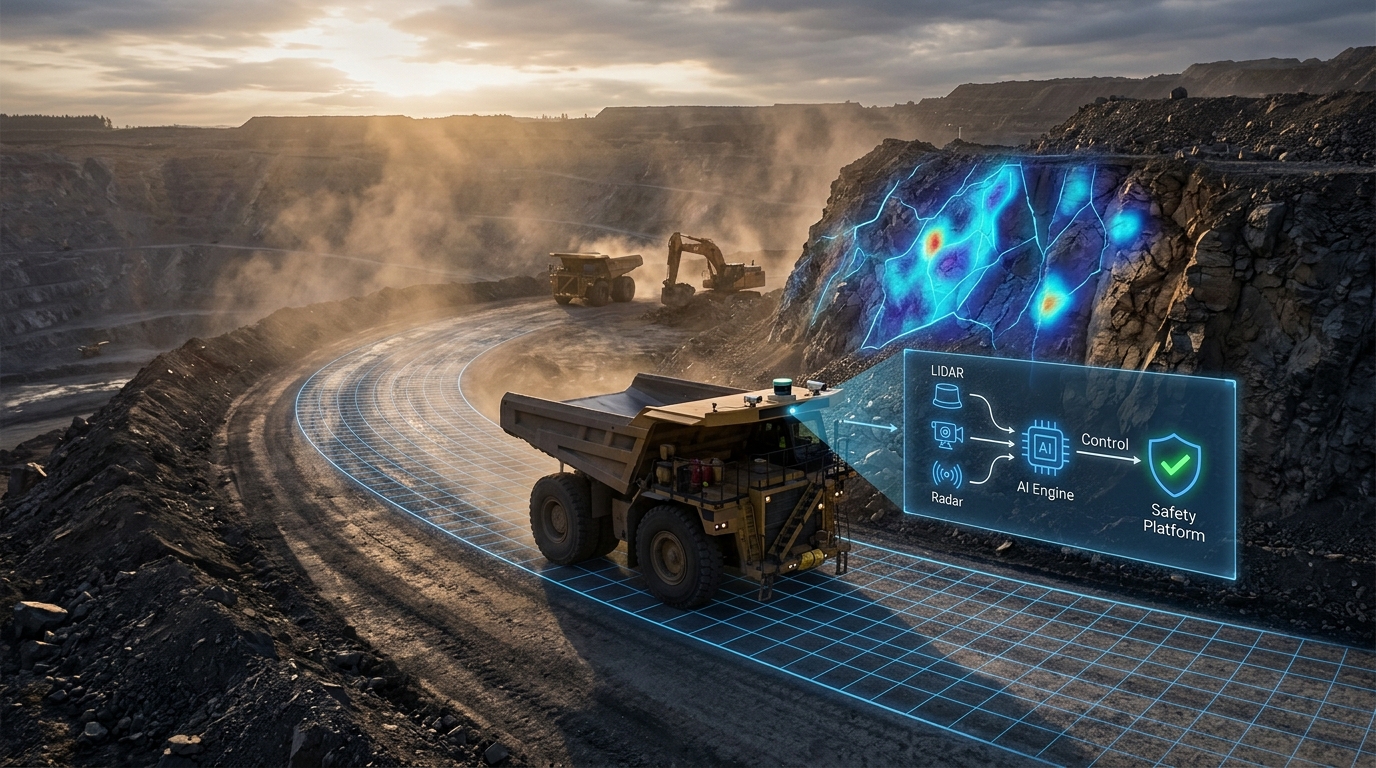 Field operations with AI-assisted safety monitoring.