Write a forward-looking leadership article for mining and heavy-industry executives, grounded in operational reality. Connect the topic to a known challenge in high-consequence work — investigation quality, control assurance, or SHMS consistency — and show how evidence-anchored AI changes the outcome.
Navigating the Next Frontier: Why AI Governance is a Strategic Imperative for HSE in Heavy Industry
The heavy industry landscape is evolving, driven by unprecedented data volumes and the transformative potential of Artificial Intelligence. For mining and construction executives, the question is no longer if AI will impact HSE, but how it will be managed to deliver tangible, verifiable improvements. Unchecked AI deployment, without robust governance, risks introducing new complexities and vulnerabilities into already high-consequence environments. This isn't about stifling innovation; it's about strategically harnessing AI's power while mitigating its inherent risks. Effective AI governance acts as the bedrock, ensuring these powerful tools enhance our safety and risk management frameworks with precision and accountability. It’s about moving beyond pilot projects to integrate AI as a trusted, auditable component of your operational fabric, protecting your workforce, assets, and social license. Proactive leadership in this domain isn't just prudent; it's a strategic imperative for maintaining operational excellence and achieving sustainable safety performance.
Beyond the Black Box: Elevating Incident Investigation Quality with Verifiable AI
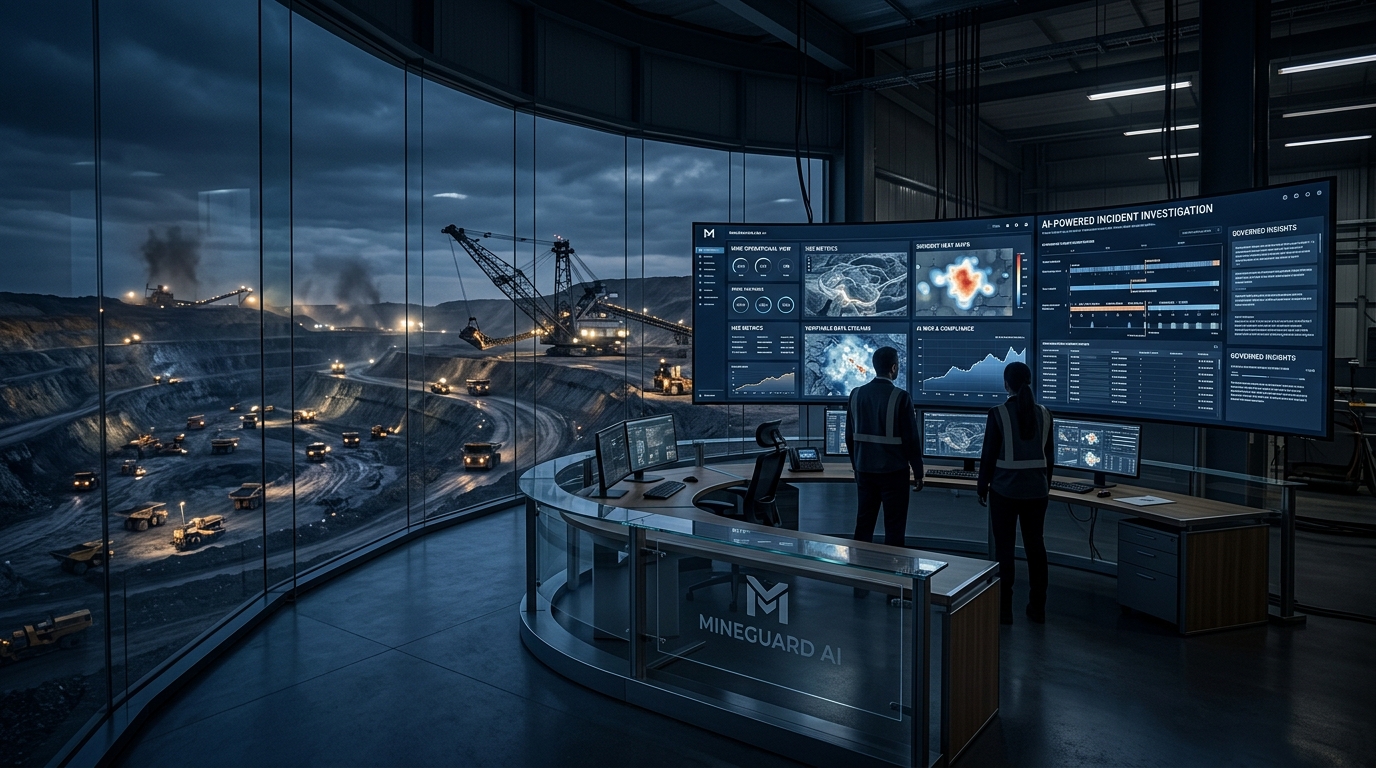
Incident investigations in heavy industry are critical, yet often hampered by incomplete data, human bias, and the sheer volume of information to process under pressure. Current methodologies, while foundational, can struggle to consistently uncover subtle causal factors or systemic control deficiencies buried deep within operational data. This is where verifiable AI offers a profound shift. Imagine an AI capability that can autonomously sift through millions of data points – sensor readings, maintenance logs, training records, operational procedures – correlating seemingly disparate events with unparalleled speed and objectivity. MineGuard’s evidence-anchored AI doesn't present a "black box" outcome; instead, it highlights specific data points and their relationships, offering a transparent audit trail of its reasoning. This empowers investigators to move beyond surface-level observations, revealing hidden patterns, validating hypotheses with concrete evidence, and identifying root causes and control failures with a new level of precision, directly elevating the quality and actionable insights derived from every investigation.
The MineGuard Difference: Anchoring AI in Operational Evidence, Not Assumption
Many AI solutions promise transformative results, yet often lack the operational credibility essential for high-consequence environments. The MineGuard difference lies in our unwavering commitment to evidence-anchored AI. We don't build models on abstract algorithms; we rigorously train and validate them against the verifiable realities of your site-specific operational data. This means our AI understands the nuances of heavy machinery, the specific environmental conditions of a mine, and the intricacies of your safety management system. Our systems are designed for transparency, explaining their conclusions by pointing directly to the underlying data – whether it's a sensor reading, a procedural deviation, or a historical incident report. This inherent explainability is crucial; it builds trust, allows for human oversight, and ensures that every AI-driven insight is actionable and auditable. With MineGuard, you're not just deploying AI; you're deploying intelligence that speaks the language of your operations, grounded in irrefutable evidence, not speculative assumptions.
Architecting Trust: Essential Pillars for Accountable AI Deployment in High-Consequence Environments
Deploying AI in high-consequence environments demands a robust framework built on trust and accountability. This isn't a nebulous concept; it's a series of tangible pillars that must be meticulously constructed. Firstly, Data Provenance and Quality are paramount – knowing where data originates, its integrity, and its relevance. Secondly, Explainability and Transparency ensure that AI decisions are not opaque, but understandable and auditable, allowing human experts to validate and intervene. Thirdly, Human Oversight and Intervention must be embedded into every workflow, designating clear roles for human review and ultimate decision-making. Fourthly, Ethical Guidelines and Bias Mitigation are critical to ensure fairness and prevent unintended discrimination. Finally, Continuous Validation and Performance Monitoring guarantee that AI models remain accurate and relevant as operational conditions evolve. These pillars collectively form the foundation for an AI ecosystem that is not only powerful but also trustworthy, responsible, and fully accountable to your safety objectives.
From Reactive Controls to Proactive Resilience: The Executive Advantage of Governed AI
For executives, the strategic advantage of well-governed AI extends far beyond individual incident improvements. It represents a fundamental shift from reactive control measures to a proactive, resilient safety ecosystem. By leveraging evidence-anchored AI, leaders gain unparalleled foresight into emerging risks, potential control degradations, and systemic vulnerabilities before they manifest as incidents. This predictive capability enables targeted interventions, optimising resource allocation and ensuring that critical controls are robustly maintained. Imagine identifying leading indicators of fatigue-related incidents across your entire fleet, or foreseeing equipment failure risks with precision. This isn't just about reducing incident rates; it’s about enhancing overall operational efficiency, minimising costly downtime, and protecting your social license through demonstrably superior safety performance. Governed AI empowers executives with the intelligence to make data-driven decisions that build enduring resilience, transforming safety from a cost centre into a strategic asset.
Leading the Shift: Your Mandate to Build a Future-Proof Safety Ecosystem
The imperative to embrace and govern AI in heavy industry HSE rests squarely with executive leadership. This isn't a task to delegate entirely to IT or HSE departments; it demands a strategic vision and a commitment to cultural transformation from the top. Your mandate is to champion the integration of evidence-anchored AI, establishing the governance frameworks that ensure its ethical, transparent, and effective deployment. By doing so, you are not merely adopting new technology; you are actively architecting a future-proof safety ecosystem that leverages the best of human expertise augmented by intelligent systems. Investing in robust AI governance is an investment in your people, your assets, and your company's long-term sustainability. Partnering with specialists like MineGuard AI, who understand the unique demands of high-consequence environments and prioritise verifiable evidence, is key to navigating this shift successfully and securing a safer, more productive future.
Cinematic industrial editorial — AI safety context.