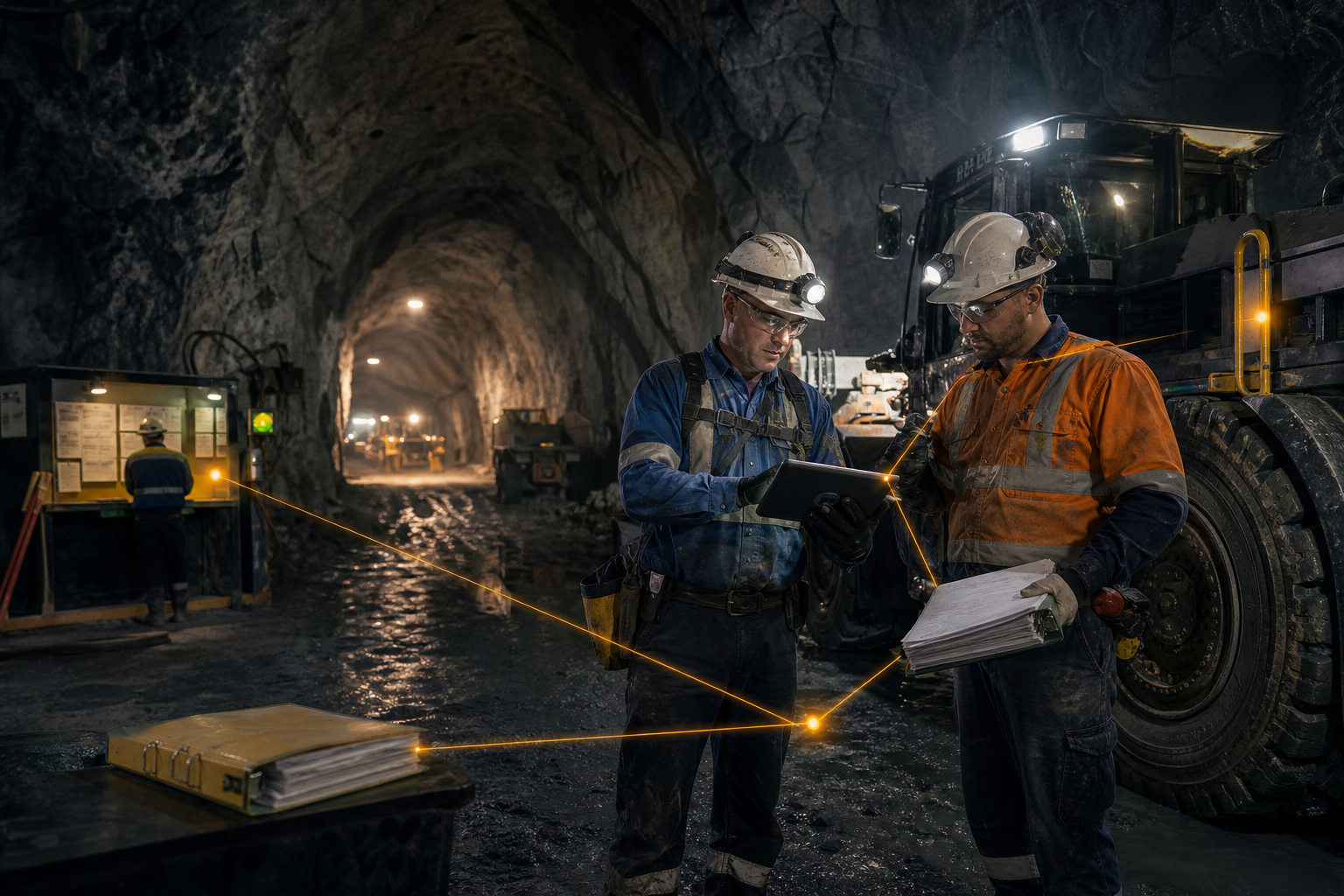
Contractor safety is often governed as a sequence of procurement gates: prequalification, induction, competency checks, permit approval and supervision. Those controls matter, but recent evidence points to a harder leadership problem.
Serious failures can emerge between organisations: where the mine's standards meet a contractor's methods, where accountabilities overlap, where time pressure changes the plan, and where evidence is split across systems.
That makes the contractor interface a safety system in its own right. It should be designed, tested and investigated with the same discipline as any other high-consequence system.
The warning is in the system, not the badge
A 2026 peer-reviewed study analysed 17 publicly available Queensland coronial inquests into mining fatalities from 2004 to 2024. Researchers identified 89 distinct contributory factors and 173 relationships across the mining system. While many factors were recorded at frontline levels, the analysis found that risks were shaped by upstream influences including governance, standards, supervision and organisational arrangements.
The study also distinguished contracted workers from direct employees. Among the issues identified were uncertainty over which organisation's policies applied, gaps in training and competency, and risks created by decisions at higher system levels. Its conclusion is not that every contractor faces the same risk. It is that contractor status can create a distinct set of interfaces that investigations and controls must examine.
The global data makes that interface commercially and morally material. ICMM's 2024 safety benchmark reported that contractors accounted for 19 of 42 fatalities and 58% of hours worked. Those figures do not show a higher contractor fatality rate for that year, but they do show that contractor work is inseparable from any credible fatal-risk strategy.
The latest picture remains sobering. Reporting on ICMM's 2025 data found that two catastrophic underground incidents caused 13 of the year's 39 fatalities, and both involved contract workers. At the same time, total recordable injuries across member companies reached their lowest annual number since collection began. The lesson is familiar but important: aggregate injury improvement does not, by itself, prove that the interfaces around fatal risks are controlled.
A recent incident shows how boundaries fail
The NSW Resources Regulator's causal investigation into the January 2025 polyurethane foam fire at Perilya's Southern Operations is a useful case study because no one was injured, yet the potential consequences were severe.
The fire led to the evacuation of 46 workers and left five personnel in a fresh-air base. The Regulator described a systemic breakdown involving contractor management, hazard awareness, procedural compliance and risk governance.
Its report identified failures to verify relevant competencies, inadequate assessment of the contractor and product, poor adherence to site risk and contract-management processes, reliance on undocumented knowledge, and time or productivity pressure. The recommendations extended across contractor management, chemical management, emergency planning and regulatory guidance.
This is what an interface failure looks like. No single checklist explains it. The breakdown sits across selection, information quality, competence, site standards, task planning, supervision, change and challenge.
Shared duties require shared operational truth
Under Australia's model WHS framework, a duty cannot simply be transferred to another party. Safe Work Australia says that when duty holders share responsibility for the same work or workers, they must consult, cooperate and coordinate so far as reasonably practicable. They need a shared understanding of hazards, interacting activities, affected workers, controls and responsibility.
Mining legislation and obligations vary by jurisdiction, so sites should test their arrangements against the law that applies to them. But the operating principle is broader: a contract can allocate work; it cannot make a hazardous interface disappear.
For leaders, the assurance question is therefore not, "Has the contractor completed our process?" It is, "Can both organisations demonstrate the same current understanding of the work, the controls and the conditions that would stop or change the job?"
Five executive tests for contractor-interface assurance
1. Reconcile the systems before mobilisation
Compare the contractor's procedures, task risk assessments, competencies and emergency arrangements with the site's SHMS, principal hazard plans and critical-control standards. Resolve contradictions explicitly. Silence is not alignment.
2. Define control and decision ownership
For each material risk, name who sets the standard, who implements the control, who verifies it, who can stop work, and who approves a change. Where responsibilities overlap, define the hand-off and the evidence each party must provide.
3. Build change triggers into the work
New products, altered methods, unfamiliar equipment, schedule pressure, personnel changes and emerging conditions should trigger reassessment. The trigger must be operationally visible and connected to a decision, not buried in a document-control process.
4. Test evidence, not administrative completion
A completed induction or signed risk assessment shows an activity occurred. It does not prove that the people are competent for the specific task, that the control is present, or that the method remains valid. Assurance should test the claim against observable evidence.
5. Investigate across organisational boundaries
After an incident or high-potential near miss, do not stop at the last action of a worker or supervisor. Examine procurement assumptions, contract design, document conflicts, competency evidence, time pressure, supervision, change management and escalation. Corrective actions should strengthen the system that shaped the event.
Where evidence-anchored AI can help
The challenge is not a lack of information. It is the effort required to connect controlled documents, task evidence and investigation material without losing context or accountability.
MineGuard AI's SHMS AI is designed to ingest safety management system documents, procedures, JSAs or WRACs, principal hazard plans and standards; check them for gaps and contradictions; and return clause-level findings with citations. Its published use cases include testing contractor documents and task packs against site expectations. Outputs are designed for human review, with the organisation retaining the decision.
When an event occurs, Incident AI supports a separate but related need: structuring evidence from documents, emails, PDFs, photos and statements; building evidence-linked timelines; preparing interview questions; surfacing evidence-gap suggestions; and drafting investigation material. MineGuard states that findings and outputs require investigator review and approval before export.
For organisations still defining the operating model, MineGuard AI Consulting offers documented services covering SHMS consistency, investigation workflows, data readiness, governance, workflow transformation and implementation design. The objective is not to automate accountability. It is to make the evidence chain more reviewable while keeping competent people responsible for decisions.
MineGuard's trust framework states that its workflows are human-in-the-loop, with evidence traceability and named approval. Those boundaries matter in contractor safety, where an apparently confident output must never replace verification with the people who understand the work and the conditions.
The leadership move
Contractor assurance should not be owned only by procurement, HSE or the contract manager. It is a cross-functional operating system that needs an executive owner, a common evidence model and explicit decision rights.
Start with one high-consequence contractor workflow. Map the organisations, documents, controls, approvals and change points. Then ask a simple question at every interface: What evidence would show that both parties understand the same risk and are acting on the same control standard today?
That question turns contractor management from a compliance sequence into a living safety system.
Book a MineGuard AI walkthrough to explore how evidence-anchored SHMS review and human-led incident investigation can strengthen contractor interfaces without delegating accountability to AI.
Key sources
- Newnam et al., Safety Science: Analysing coronial inquests into mining fatalities, 2026
- NSW Resources Regulator: Causal investigation — polyurethane foam fire at a metalliferous underground mine, 2025
- Safe Work Australia: Consulting, cooperating and coordinating with other duty holders
- ICMM: Safety Performance — Benchmarking progress in 2024
- CIM Magazine: ICMM highlights the need to strengthen critical controls, 2026
- MineGuard AI: SHMS AI
- MineGuard AI: Incident AI
- MineGuard AI: Trust & Security